
|
| Welcome | Prospects | Projects | Publications | Papers |
| Methods | Purposes | Other | Links |  |
An old concise on the filtration flow within peat (by Prof. K.E. Ivanov)Groundwater flow within peat soil can be measured with the use of the following laboratory installation (Fig. 1) 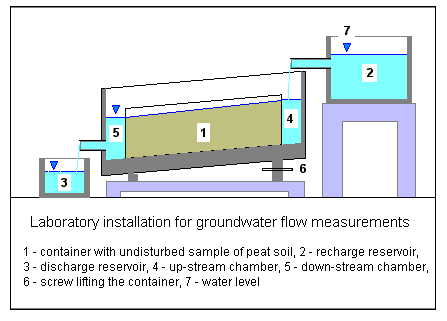 Figure 1. Filtration flow: Layout of laboratory measurements The big chamber which contains the native peat is sized 1.3 long and 0.5 m wide by 0.7 m in depth. Core of the peat soil is sampled undisturbed by mid-of-winter freezing of the ground. Notably is that the long side of the core should be parallel to the surface slope (!) Experiment is started when the peat core installed into the container becomes entirely thawed. It consists of the measurements of filtration flow discharged to the tank by various slope of the chamber while water level is slowly decreasing. The slopes should be near to those peculiar to native peat bogs: from 0.0005 to 0.015 (it is exaggerated in the above Figure). Filtration coefficient (saturated soil water conductivity) is defined as the ratio of water discharge to the cross-section and slope of the chamber. 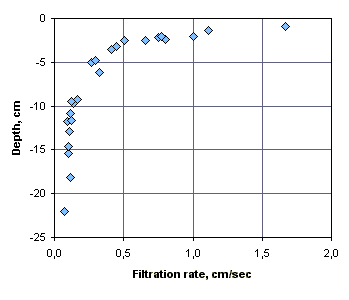 Figure 2. Filtration rate determined in laboratory as changing with depth within native peat soil Multiple series of the observation allow to define how the filtration coefficient changes within soil profile (Fig. 2). The given picture is typical of the native peat soil with its upper friable layer (turf) and much more dense substrata. As was found, the ground water flows preferably within that upper sub-layer, practically never creating the surface flow (except for a deeply frozen peat previously saturated of water). The flow rate is determined as usual by Darcian law. Experienced some later, Prof. V.V. Romanov found that by filtration within natural turf probably near to one fifth of the ground water volume flows through capillary pores just above the water table. That part of the "ground" water is moving under capillary tension, it is mainly confined within tissue of the wetland moss decayed. Hence, the pore pressure greatly affect the water flux and should be measured independently. Following the guidance, I studied it too, by using the special device called "capillarimeter", the small glass container with membrane filter connecting to a gauged tube. Experiments of that time (late 1970s) have resulted in my bias to hydro-physics up today. References Ivanov, K.E. Hydrology of the forest zone wetlands. - Leningrad, Gidrometeoizdat, 1957 |
|
|
|
Hydrosphere © 1990 — 2005 Vladimir A. Shutov |