
|
| Welcome | Prospects | Projects | Publications | Papers |
| Methods | Purposes | Other | Links |  |
Methodology for Hydrological Support of Pipeline EngineeringAn applied hydrology project Purposes This applied study project have been proposed to:
Problem statement There are a great deal of large gas pipelines laid and lying now from the rich fields in north Russia toward its centers of population and industry and further away to western Europe. They subject of many natural factors which are hazardous for it, and incidentally for the environment due to possible accidental breaks of the pipeline and gas explosion. So, the water cycle related environmental risk factors appear as creeping and develop as destructive. Lying across numerous small rivers and brooks, the pipe is stretched over the stream water stage. It can be as a weir due to uncertain prediction of flood. Such cases arise in wide flat-bottom valleys and lead to local inundation of surrounding area. Since the pipe can act as a dam for the subsurface flow, the technogeneous disturbance could occur of the ground water regimes. Particularly, the boreal coniferous forest suffer by this occurrence being restricted from up-slope water inflow. Soil cover has particularly been disturbed by pipeline construction, that leads finally to soil erosion either as gully erosion or as slow creep. Both these events are hazardous, affecting the possible rupture of the pipe. This problem is complex due to coupled influence of surface flow conditions, soil texture and water properties. Core of the project Many of risk factors above are hydrology-related. We need urgently to improve forecasting the flood flow conditions as well as the water regimes of wetlands and soils, that is the core of the proposed study project and images as in annexed Figure. Study principles To achieve this aim we have to apply all the data and knowledge obtained: landscape and hydrological regionalization, climate - precipitation data and snow cover extent, soil water properties, etc. We shall process the input data statistically as improved frequency distributions and long-term data series. We must attempt to appreciate all the hazardous factors by quantifying them, and to study them to develop the new methods to predict them, as far as possible. Methodology principles presumed to be imply to the project are in particular:
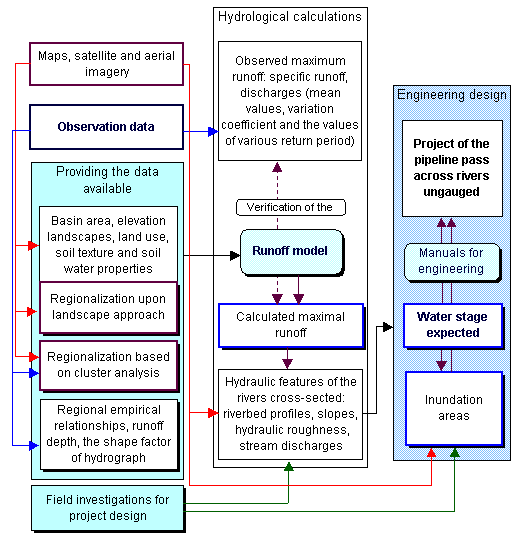 Further development of declared study program may generally be foreseeable in:
Return
|
|
|
|
Hydrosphere © 1990 — 2005 Vladimir A. Shutov |