
|
| Welcome | Prospects | Projects | Publications | Papers |
| Methods | Purposes | Other | Links |  |
Adjustment and Special Processing the Radar Precipitation Data for Engineering HydrologyValday Branch of State Hydrological Institute. 175400, Valday, Pobeda Street, 2, Russia. Abstract Problems are addressed of inaccuracies and adjustment of the radar data with special attention to the winter precipitation measurements for a hilly area in northwestern European Russia. Calibration of the Valday radar has been done by using a special rain-gauge network over the Polomet' river watershed. The ground network was consisted of 38 gauged sites aggregated in a number of nested groups. Hourly (3-hourly) rates were interpolated into grid cells. The ratio gauge/radar was found varied from 0,5 to 3,8 for 3-hourly rates, and less ranged (from 0,7 to 2,2) for daily amounts. Of particular importance is that the gauge/radar ratios are distributed not randomly. By analyzing their maps, one can infer about specific inaccuracies which are correlated with the terrain features. On winter, when the radar can underestimate those snow amounts fallen onto the hills, there is a considerably scattered ratio between snow water equivalent (SWE) and accumulated radar precipitation estimates. Based upon our experience, the problem seems to be clarified. Methods are proffered to process the radar-based precipitation data as convenient to be applied just to engineering hydrology. Two main properties of precipitation fields have been examined: (1) spatial coverage, (2) empirical conditional frequency of "at-cell" rain rates by specified spatial average values. Examples of the data processing and analysis are given to expound upon the ideas of how to describe precipitation patterns statistically. For instance, a procedure is proffered to reveal those rain rates exceeding that threshold correlated with antecedent wetness of a drainage basin. A previous classification was done of the radar images using the approach based upon cluster analysis. Two types of rainfall fields with three subtypes each were identified as depending on intensity and preferable localization of heavy rainfall on the area examined. Two procedures are developed for hydrological calculations with the use of radar precipitation and its spatial characteristics. Both are based on the so-called "extreme intensity" method accepted in Russia for engineering when the maximal (peak) flows and their frequency are to be determined. The peak flow conditions have been simulated and represented as spatial frequency curves for runoff depth on conventional watersheds 10x10 km in area composed of different soils and produced, respectively, different runoff rates. Presented allows us to detect probabilistically on where there would be runoff depth exceeding some specified value, or in opposite, to evaluate what a flow may be expected by given rain rates fallen on given area. An expert outlook is given finally to how to deal with the precipitation space-time series in extended studies of the climate variability and water resources assessment for future water projects.
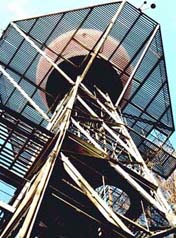 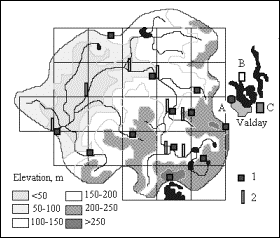 A). Photo picture of the X-band weather radar, type MRL-5 located in Valday, Russia. B). Scheme of experimental study area: the Polomet' river basin (elevation is depicted) represented as the grid of 10x10 km cells, the Valday town and the radar site (A), small catchments - Usadje (B) and Tajezhny (C), rain gauge (1) and river discharge (2) sites. 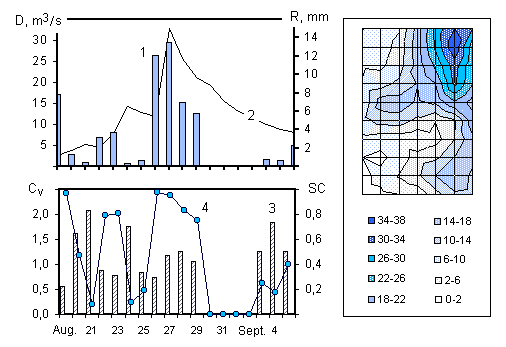 Analysis of a rainfall-induced flood event with the use of radar precipitation data 1). spatially averaged rainfall rates (mm); 2) the Polomet' river discharges (m3/s); 2). spatial variability (Cv) of precipitation; 4) spatial coverage (SC) of the basin. Mapped rates (mm) show how the most intense storm (Aug. 27) covers the area. AGU Western Pacific Geophysics Meeting. |
|
|
|
Hydrosphere © 1990 — 2005 Vladimir A. Shutov |