
|
| Welcome | Prospects | Projects | Publications | Papers |
| Methods | Purposes | Other | Links |  |
IntroductionSeasonal snow cover (Figure 1) dominates natural landscapes of Russia and Canada over 4-6 month. It is a powerful factor of environmental processes and human health and activity. Snow cover studies results in manifold applications to business and is of great importance for geography and climate. These are: flood forecasting, design water projects, calculation of floods and soil freezing for construction engineering, etc. Fighting against snow drifts on roads and protection of fertile soils against water erosion are not possible without reliable data on snow cover and its spatial distribution. 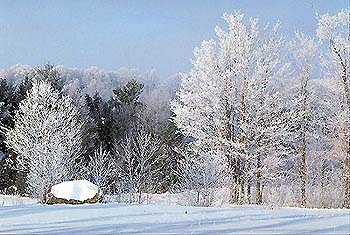 Figure 1. Genial snowy landscapes of Eastern Europe gladden us still every year, but they can disappear after irreversible climate modification. We must prevent it. Snow crystals originated from various conditions have various forms: from sparkled needles falling out of thin alto-stratus clouds by a frosty weather to large flakes while usually mild European or Japanese winters. By classifying the snow crystals, one may define indirectly the evidence of their thermal history inside a cloud system. Primary snow crystals are destroyed due to wind before packing them into a snow pack. At the same time, small crystals in deep horizons of the snow pack grow due to metamorphism and image like salt crystals. This results from water vapor diffusion from out soil through a snow pack. Snow surface is often covered of a crust originated due to intensive solar radiation. The crusts become burial under new fallen snow, thereby the old snow pack has a layered structure. Density or specific weight of "dry" fresh fallen snow is about 0.06 - 0.10 g.cm-3, but it increases gradually to 0.30 g.cm-3 at late winter. Extremely arid climate of Mongolian plains affects such a compacted snow pack covered by a crust cracked under foot like a ceramic tablet. Winter precipitation amount defines the snow depth (snow thickness) only on average, as it generally covers rugged relief of underlying land surface. Wind-related re-distribution of snow are significant by the snow storms over great plains of North America, Siberia and Kazakhstan. Snow surface becomes there firm and rough as a washing board. In an early spring the solar light corrodes it that affects some cavernous snow surface. This particularly occurs in mountains where there are very large snow ridges of snow inclined depending on incident angle of the sun rays. They are called repenting monks. Snow evaporates under influence of solar radiation and sometimes, e.g. in extra-arid Mongolian plains it disappears almost without generation of any melt water. Evaporation from snow is usually from 10 % to 25 % of the total snow water content. Snow melt is affected by sun light, wind and air temperature. Budget of these is the energy resource available for melting. Therefore, the snow melt is observed even by negative temperature while strong solar energy flux. Rainfall to the snow surface stimulates for snow melt that is usual in humid climate of the mountains in Norway, Alaska and western Canada.
|
|
|
|
Hydrosphere © 1990 — 2005 Vladimir A. Shutov |