
|
| Welcome | Prospects | Projects | Publications | Papers |
| Methods | Purposes | Other | Links |  |
Landscape zonesSnow cover is distributed over plains mainly under global atmospheric circulation which conditioned wetness, and under local peculiarities of relief, land use and vegetation. The same factors play over hills and low mountainous terrain, there is however another forcing: elevation and macro-slope aspect defined the climate wetness. These regions of Russia and nearby countries, Bjelorussia, Ukraine and Poland are food productive, have a dense population and great industrial importance, that provokes there a great flood damage. Hence, we have to make efforts for detail investigation of snow cover to provide quite realistic hydrological forecasts. Karpatian mountains is that area of Central Europe where the rivers such as Tisa, Vistula and Dniestr accept melt waters, accompanied with considerable liquid precipitation, thereby very disastrous floods frequently damage the region. Let us examine the data provided from long-term measurements at mid-elevation zone of a beech-and-oak forest. Monthly precipitation for winter amount to 120 mm at 700-800 m a.s.l. and to 150-190 mm in elevated zone of mixed forest partially with spruce stands located at 1000 m. There is a peculiar snow accumulation budget (Figure 2),that is the snow melt process delays at higher elevation zones (dark bars at the diagram). 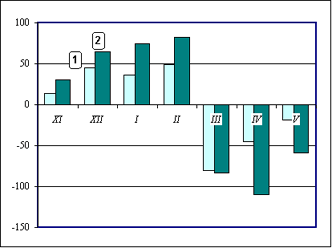 Figure 2. Monthly budget of snow accumulation and snowmelt (mm) for two Karpatian river basins Let us examine another case related to the southern Urals Mts. and foothills which is very industrialized region of Russia where, as it was requested, the runoff calculations for the Belaja river basin have been improved. Based upon long-term data series, we specified there the regions by particular winter precipitation and different altitudinal gradient varied from 30 to 110 mm per 100 m. We distinguished in this area a number of landscape types of various vegetation and snow water equivalent respectively. As was found, the latter is less than precipitation totals (117 snow vs. 141 mm precipitation) over the prairies where the snow is blown from open hill slopes into the hollows, in opposite, the snow accumulation is prevailed (263 snow vs. 212 mm precipitation) under forest conditions, as well as in deep river valleys. Have you examined that the snow and precipitation amounts are correlated, you draw a scatter-plot (Figure 3), in which those sites are clearly shown, where snow drifting prevails, as deviated downwards from the straight line of 45 degree. It may balance the snow water equivalent with total precipitation minus evaporation as the ratio, which testifies where the snow drifting is more intensive, or how much the loss of water is from an open field. As was found, the latter amounts to 30-45 % of total input over a plain, in opposite, the above ratio is more (up to 1.54) at those sites which are laid in forest zone. And, this is only macro-effect of landscape conditions, by further analysis we can ascertain the local influences of how the tree species, land use and other attributes of the surface can affect the snow cover and its distribution at local scale. 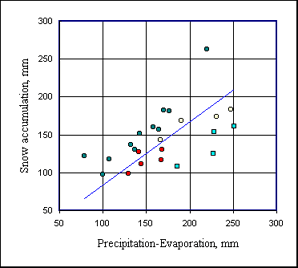 Figure 3. Relationship between precipitation minus evaporation totals and snow accumulation |
|
|
|
Hydrosphere © 1990 — 2005 Vladimir A. Shutov |