
|
| Welcome | Prospects | Projects | Publications | Papers |
| Methods | Purposes | Other | Links |  |
Snow meltingSnow melting usually depends on energy exchange in the snow surface - atmosphere system determined through the heat budget equation given as follows:
where M is the heat storage available for snow melting, Q is solar radiation income, a is snow surface albedo, J is net long-wave radiation, P and LE are sensible and latent turbulent fluxes in the atmospheric surface layer. All the components term in MJ.m-2 per a time unit. Energy fluxes at the "snow-atmosphere" interface have been described as follows
where CH and CE are coefficients of turbulent transfer in the atmospheric boundary layer, Ts and Ta are the surface and air temperatures, qs and qa are water vapor content (g.cm-3 ) near the surface and in the air, U is wind speed (m.s-1) measured as usual at 2 m level above the land surface. To determine the solar and long-wave radiation fluxes, we need to conduct so-called actinometric measurements. Else these may be evaluated using empirical equations relating the cloudiness or sunshine duration. The energy fluxes are defined by so-called gradient measurements with taken into account the complex factor of atmospheric stability. The ratio of reflected and incident solar energy fluxes is known as the surface albedo. It is of great importance to regulate snowmelt rates. We have studied it on special plots with intact and artificially contaminant snow. It is doubtless that dirty snow melts more intensively, and this promotes for climate change, and for snow management at a regional scale. To acquire snowmelt rate as the amount of liquid water, we should divide the M-value derived from Eq. (4) by so-called latent heat capacity l = 0.334 MJ.kg-1 and again by snow density. Received will signify the melting rate of continuous snow cover. After that it starts to digress, we must allow for snow coverage FS (see above) as a reductive factor. Snow pack initially detains some portion of liquid water inside, then it releases this portion as the water yield that is affecting from the snow melt intensity as well as from permeability and grain size of the snow. There are more simple approaches to evaluate snowmelt by empirical relationships between temperature, radiation and snowmelt rates (Figure 7). Sloping of these curves are so-called radiation degree day factors and they vary in diverse climatic and landscape conditions. In spite of their in-time instability, these are successfully used for calculation in many of the hydrologic simulation models especially those designed for forested and remote mountainous terrains. 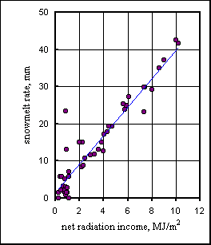 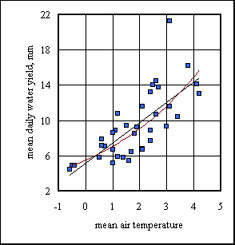 Figure 7. Snow melt rate as affected by air temperature and net radiation at Valday The water balance method is another way to evaluate and control snowmelt as water yield from snow pack determined as an amount measured by special pan (lysimeter) or as an outflow from impermeable concrete plots. This way is assumed as a direct measurement and it permits to detect daily course of snowmelt under influence of undulating air temperature, radiation fluxes and rainfall on the snow surface in the course of time. By using the water balance estimation, we received and examined the long-term time series of snow accumulation, of snowmelt rates as mean values and daily maximum at Valday that gives a new allowances for climatic research (Figure 8). 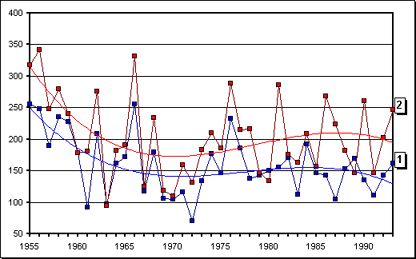 Figure 8. Time series of snow water equivalent (1) and melt water yield from the snow (2) They are representing smoothed with use of cubic polynomials to reveal trends and wavy-shape undulations. As was found, we experience now a period with descending snow water equivalent and snowmelt (as daily amounts). In opposite, hourly maximum of snowmelt intensity vary irregularly. Total water yield from the snow pack gradually outgrows the snow accumulation due to increasing rainfall amounts during snowmelt season in particular for last two decades. Thus, the local climate peculiarities are revealed. One may also proves the major statistic parameters of long-term data or as "chain of events", or as frequency (probability) function. |
|
|
|
Hydrosphere © 1990 — 2005 Vladimir A. Shutov |