
|
| Welcome | Prospects | Projects | Publications | Papers |
| Methods | Purposes | Other | Links |  |
Snow Management in Agricultural LandscapesValday Branch of State Hydrological Institute. 175400, Valday, Pobeda Street, 2, Russia. Abstract. Snow accumulation conditions in Russian and northern Kazakhstan cereal productive areas are examined based upon experimental study results. Snow drifting and evaporation from snow were studied particularly. The local snow accumulation coefficient (LSAC) is defined as the ratio of snow water equivalent (SWE) and corrected winter precipitation minus evaporation from snow. The LSACs were mapped, as well as snow evaporation, to detect those areas with prevalent snow accumulation and snow drifting. Field studies showed, that some water supplement is and overland flow decreases only when the frozen soil could be impermeable without any snow retention. In other cases the efficiency of such snow management will be negligible due to increasing snow evaporation from rugged and dirty snow. Introduction Research in snow hydrology has a manifold applications including those are of importance to climate studies. In particular, the snow management (Federer et al., 1972) is to regulate snow, its spatial re-distribution and melting towards profitable agriculture. Snow retention measures throughout Russia and Kazakhstan were mainly to decrease the snow drifting and optimise thermal regime of soils in regions with winter cereal agriculture (Shul'gin, 1986). To estimate the efficiency of the snow retention, the State Hydrological Institute (SHI) undertook a special field studies in northern Kazakhstan. We have developed a new methodology of the snow retention through the experimental studies in snow physics and the water budget. As a result from these investigations (Delarov et al., 1985, Shutov, 1990, Shutov and Kaljuzny, 1988), we may affirm that managing snow cover on an agricultural field can provide an additional water yield due to decreasing snow removal and promote for soil water replenishment. It is practiced, in particular, in northern Kazakhstan and Mongolia where snow ridges are built by using a snow plough. Runoff creating surface on a slope imagines then as a regular alternation of the strips with different infiltration capacity of underlying soil. Melt water percolates well permeable soil under the snow ridges as well as below deep snowdrifts captured by special snow fences. Field studies taken place there showed, that some water supplement is observed and overland flow decreases only when frozen soil could be impermeable without any snow retention. In other cases the efficiency of such snow management will be negligible. Moreover, we can expect certain additional losses due to increasing snow evaporation from rugged and dirty snow particularly from steep southward slopes. Predicting these effects may be after mid-of-winter snow surveys. Snow drifting and local snow accumulation When (as in Russia and Kazakhstan) the plains are dissected by ravine and lowering networks, the substantial non-homogeneity in the snow cover accumulation takes place mainly conditioned by storm snow drifting. This affects overland flow and thermal and water regimes of the soils. The ratio of the snow water content at a local site and that spatially averaged for whole plain fields we called the Local Snow Accumulation Coefficient LSAC (Shutov, 2000a). Its values can reach to about 3 and more depending on the wind speed and on geomorphic structure of the area. The LSAC can then be obtained from meteorological data and expressed as the ratio of snow water content to the sum of precipitation minus evaporation and melt water losses. The LSAC can be used as the basic criterion which allows to map snow cover accumulation over an area of interest. Resulting from that, the calculation and mapping have been done of LSACs (Petropavlovskaja and Kaljuzny, 1986) for the northern Kazakhstan. As was found, the annually averaged LSACs are among 0,6 and 0,9 for most of the area varied inter-annually while the seasonal snow budgets can be either positive or negative as conditioned by relief, wind directions prevailed while snow storms. Evaporation from snow We have conducted the measurements of evaporation from snow by using the shallow pan lysimeters 500 cm2 by 6 cm depth to these water losses be reliably defined. We have taken into account all the affected factors: solar radiation income, air humidity, wind speed, surface albedo and aerodynamic roughness of snow. As a result of experiments (Shutov, 1991, 1997), we found that snow evaporation depends on solar radiation. Besides, the snow evaporation depends on wind velocity and the roughness of the surface. The equation for it becomes alike Penman. Profile measurements were shown that the roughness factor for rugged surface due to snow ploughing is mush more than that for intact snow surface. Thereby, the turbulent transfer snow-atmosphere becomes intensive. We have also studied the relationship between snow evaporation and snow pack density (Delarov et al., 1985), found it very complex that closely depends on the thermal gradient and extinction of solar radiation flux within snow pack. Based on the data obtained, we calculated and mapped (Shutov, 1990, 1991) evaporation from the natural snow cover and the evaporation losses arisen by snow management. Contamination of snow When studying snow, we encounter another problem which is a human impact on snow cover in urban areas strongly affected snowmelt and water resources generating respectively. Concentration of dust contaminants is from 10 (for a fresh snow cover) to 500 gram per square metre near highways (Glasovsky et al., 1983). We have proceeded the measurements of snow surface albedo with use of portable short-wave radiometer above experimental plots with intact and artificially contaminant snow pack. The concentration of coal ashes with admixed fine soil particles on different experimental plots were varied from 20 to 500 gram per square meter. As a result, the non-linear relationship was received between snow surface albedo and concentration. It was approximated (Shutov, 1991, 1997) as a power function. The respective equation can be used when calculation of snowmelt by heat balance are needed to be performed and while an airborne snow cover monitoring. As was found, the role of surface albedo of dirty snow increases by radiation-induced snow melt which is inherent to the prairie zone. The artificial contamination of snow can be successful there as an effective regulation of excessive snow melt rates, surface runoff and soil water erosion. Snow and the soil water budget Considering a large-scale efficiency of snow management we need to define the basic items of water budget of arable lands: the snow water content H, snow evaporation E and soil water content W or soil water supplement DW during snowmelt period. Positive effects of snow retention will be determined by taken interrelations among them into account. In fact, if H<E then any snow retentive activity is meaningless. On the other hand, when H > (DW +E), i.e. snow water content exceeds the potential soil moisture deficit, we must concentrate efforts on how to increase soil permeability by special tillage. Conditions in Russian Chernozem prairies are near to the second case, so there is a requirement for a deep plough of clay soils when there are deeply negative freezing temperatures (TF). In opposite, the northern Kazakhstan is a wide region of potential efficiency of snow retention under conditions when E < H < (DW+E). The extra-arid Mongolian plains, where the problem of soil water conservation for farming is, are near to the lower limit defined as H = E. There are ultimately low winter precipitation plus intensive evaporation from snow due to powerful solar radiation that is inherent to Mongolian climate (Shutov and Natzagdorj, 1988). Snow cover distributes there unevenly, that is conditioned by great snow drifting everywhere except for mountains. Water replenishment is main of the suggested results of the snow management. We assumed that the slope with snow ridges laid across it has an effective mechanism to reduce surface runoff and to retard removal of contaminants (Kaljuzny et al., 1985, Shutov, 1990). This is based on the concept about thermo-physical interrelation between frozen soil and melt water (Kaljuzny and Pavlova, 1981). Resulting from five-annual experiment data, we have clearly discovered empirical relationships between snow accumulation and soil water content (Figure 1). We observe there is no effective soil tillage on a silt loam without any snow management. The latter should be put into practice as provided double more soil water content when ploughing (compare 4 and 7 variances). A light sandy loam cannot be sensitive to the snow plough. We can also infer that the surface runoff varies under coupled influence of relative soil moisture and snow retention (Figure 2). Generally the runoff volume from virgin land increases due to high snow accumulation where snow pack is still undisturbed (where there is no snow management) and, snow retention allow us to modify or to reduce spring runoff and cut off its peak (maximum) value so, that may have very important environmental consequences, in particular, for preventing or decreasing outflow of fertilisers from arable land to local water bodies. 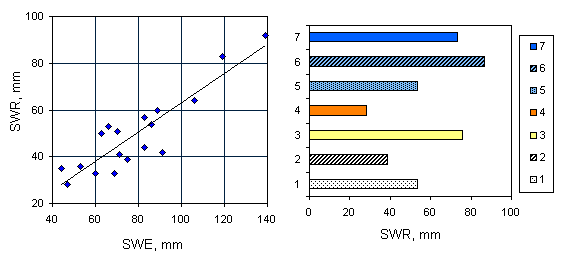 Figure 1. Soil water replenishment (SWR) by snowmelt SWR as depending on snow water equivalent (left), SWR by various soil and snow (right): Intact snow cover: virgin soil - sandy loam (1) and silt loam (2); tillage - sandy loam soil (3) and silt loam soil (4); snow management: virgin soil - sandy loam (5) and silt loam (6); tillage - silt loam soil (7) 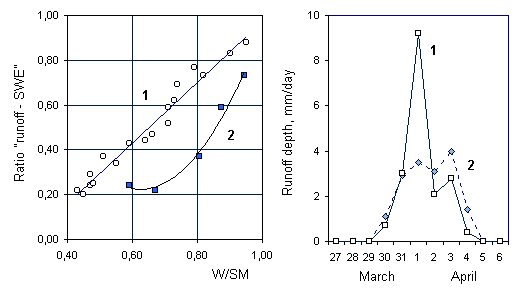 Figure 2. Influence of snow retention activity on surface runoff Left: the runoff coefficient ("runoff - SWE" ratio) vs. relative soil moisture (W/SM) Right: the daily runoff depths (mm) during snow melt period in northern Kazakhstan 1 - control plot with intact snow pack, 2 - experimental plot with snow retention We are able to evaluate the total leaching contaminants such as nitrogen if the data are available on concentration and runoff volume (runoff depth). Both these have been measured at the experimental plot which places on a hill slope. The total leaching (outflow) may be defined by total runoff volume. Hence, the aim appears to be how to retain that portion of runoff to restrain the contaminant outflow. It can be achieved, for instance, by special tillage of the soil to improve its infiltration capacity. But, another way is to retain snow on agricultural fields: it is to both prevent surface flow and keep soil water available for crops. Our intentions were to do so and, we were trying to improve the methods for snow management as an agricultural tool. References
|
|
|
|
Hydrosphere © 1990 — 2005 Vladimir A. Shutov |