
|
| Welcome | Prospects | Projects | Publications | Papers |
| Methods | Purposes | Other | Links |  |
Soil Protective Agriculture and HydrologyValday Branch of State Hydrological Institute. 175400, Valday, Pobeda Street, 2, Russia. The Soil Protective Contour Agriculture (SPCA) practice in Central Russia consists of forest shelter belts, soil ridges and terraces which contoured relief of on-slope located agricultural lands (left Figure). The SPSA are developed to regulate surface runoff and prevent soil erosion. The field investigation for SPCA efficiency were carried out on five small experimental watersheds of the Institute for Soil Protection near the town of Kursk, Russia. Hydrological support was consisted of measurements and estimation of measurement accuracy, first of all for precipitation and snow water equivalent (SWE). Preliminary results showed that: A. Quite appreciable influence of SPCA takes place on snow accumulation and, artificial forest shelter belts combined with soil ridges provide the best snow retention (Table and Figure). B. Decreasing has been discovered in spring runoff volume and peak flow depth in comparison with runoff from control watershed and runoff depth which is specific for given area. C. Impact of SPCA on ground water regime of the Chalk age aquifers has not been discovered. Table. Characteristics of the experimental watersheds with SPCA 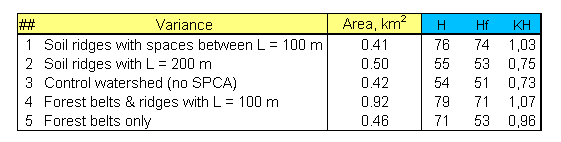 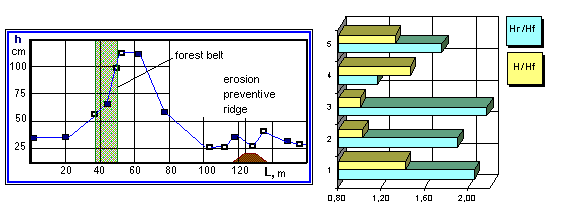
Figure. Snow accumulation on the SPCA watersheds in central Russian plain Left: SPCA construction and profile of snow depth across the ridges and forest belts Right: snow accumulation indices (H - average SWE, Hf - open field, Hr - in-ravine values) Comments: The local snow accumulation coefficient KH is defined as the ratio of total snow accumulation on given watershed and corrected precipitation minus evaporation for the period. KH-value determines snow retention efficiency of examined snow management practice. The data show that KH = 0,73 for control watershed, and KH = 1,07 for the most efficient variance of the SPCA. That is to say, the snow is generally blown from the control watershed in ravine (where the ratio of "ravine - open area" is 2,16), but, there are substantial snow drifts in the 4-th watershed so, the snow water content exceeds precipitation amount minus evaporation. |
|
|
|
Hydrosphere © 1990 — 2005 Vladimir A. Shutov |