
|
| Welcome | Prospects | Projects | Publications | Papers |
| Methods | Purposes | Other | Links |  |
A draft on fundamentals of the ASDSA — an Automated System for Data Sampling and AssimilationValday Branch of State Hydrological Institute. 175400, Valday, Pobeda Street, 2, Russia. Evaporation may be defined and indirectly measured through the latent heat flux or turbulent transfer of the water vapor into the atmosphere. To acquire the real-time data, we should rely upon an automated equipment allowing a time resolution of about 30min. There has been an experience of such a measurement system provided by the Institute for Water Automatic located in Bishkek - the capital of Kirghiz Republic (formerly a republic of the Soviet Union). Here we try to remember some principles which are basic for that system. We should start with the Penman formula for potential evaporation. Then we call for the stability function to imply the atmospheric surface layer conditions and for actinometrical observation data to receive the net radiation income. So, we can look at the figure and photo picture to imagine how these have been implemented. 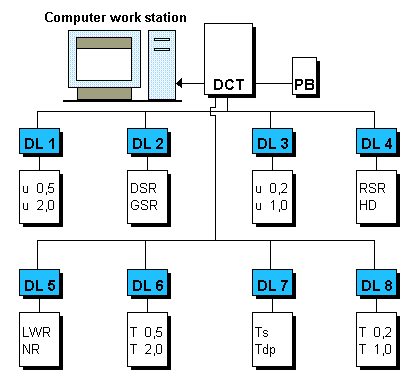 Figure 1. Scheme of the ASDSA DL - data logger, DCT - data controller - transformer , PB - power block The DLs control the respective sensors (for instance, u 0,5 and u 2,0 are wind speeds at 0,5 and 2,0 m height, DSR, GSR and RSR are diffuse, global and reflected solar radiation, etc.) 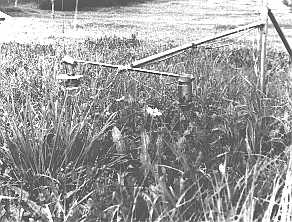 Figure 2. A photo picture of the ASDSA sensors installed at 0,2 m level Left - reflected radiation (albedo), right - long-wave irradiance from surface To obtain the actual evaporation, we used a simple variance of the profile method. Again, we should imply the function F(Ri) for the surface layer. For this aim the Richardson number Ri can be at hand which is the ratio of temperature gradient and wind speed. And, as F(Ri) is the key factor, there are a great deal of formulation for it. Moreover, there are a number of concepts and study approaches to solve this problem (Brutsaert, 1982). Generally, physics of the atmospheric boundary layer is a fascinating story, its methods and results are versatile and applicable for most environmental sciences. They allow us to describe such important phenomena as the sea-air interaction in global scale, the diffusion of plume from a power plant and, in particular, the evapotranspiration fluxes within and above the plant canopy. We proved most of the F(Ri) functions, found them only slightly dissimilar and, only for those conditions which are not usual for the study area climate. Then we inferred that it is better to use those which were tested and proved statistically. Brutsaert, W., 1982. Evaporation into the atmosphere. - D. Reidel Publ., Dordrecht, 352 pp. |
|
|
|
Hydrosphere © 1990 — 2005 Vladimir A. Shutov |