
|
| Welcome | Prospects | Projects | Publications | Papers |
| Methods | Purposes | Other | Links |  |
Evaporation Measurements and Real-time Estimation of the Climatic Humidity IndicesValday Branch of State Hydrological Institute. 175400, Valday, Pobeda Street, 2, Russia. The method of indirect evapotranspiration measurements was based upon aerodynamic (profile) approach with use of the Automated System for Data Sampling and Assimilation (ASDSA) operated at Valday, Russia. Sensors of the system were installed on stake masts above a meadow grass surface. Measurements and data processing were carried out with a computer control. Solar radiation and long-wave radiation, air temperature and air humidity, wind speed and precipitation rates were determined half-hourly by using the ASDSA sensors. The actual evapotranspiration rates were computed by using a simple turbulent transfer scheme. The potential evaporation was defined by Penman's approach with using of the radiation flux data. Received are the data of daily courses of evaporation and main factors conditioned it during a summer season (Figure 1). 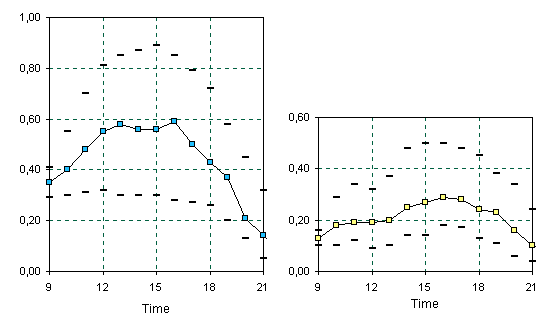 Figure 1. Time-averaged daily courses of potential (on the left) and actual evaporation (on the right) by ASDSA measurements. Deviations are shown with dashes The climatic indices of wetness are then evaluated, such as well-known Budyko's index (ratio of the net radiation income and latent heat flux R/LE), the Bowen ratio, the ratio of actual and potential evaporation (E/E0). The latter is suggested as the most suitable to operational estimating the climatic wetness indices. Daily evaporation ranges from 0,9 to 5 mm, and potential evaporation from 2,5 to 12 mm. The ratio of E/E0 oscillates from 0,25 to 0,85 around its average value equal to 0,5. Correlation (as well as discordance) between diverse climatic indices (Figure 2) are of particular interest. 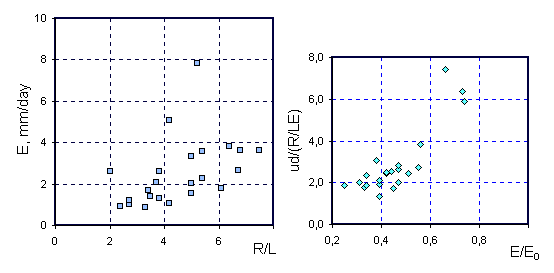 Figure 2. Correlation between the climatic humidity indices obtained using the ASDSA The values received may be expanding to a large scale, based upon suitable spatial averaging the common meteorological data and on remotely sensed radiation flux and so-called vegetation index. Actual problems however remain when going on evaporation measurements.
References
|
|
|
|
Hydrosphere © 1990 — 2005 Vladimir A. Shutov |