
|
| Welcome | Prospects | Projects | Publications | Papers |
| Methods | Purposes | Other | Links |  |
Towards Improved Land Surface Parametrization in GCMs through the Use of Experimental ResultsValday Branch of State Hydrological Institute. 175400, Valday, Pobeda Street, 2, Russia. The Land-surface Parametrization Schemes (LPS) for Global Climate Models (GCM) consist of sub-models of climate forcing processes such as evapotranspiration, soil moisture, snowmelt, overland flow as incorporated into the climate simulation models. The special experiments and long-term observation data on the heat- and water balance components may serve as quite convenient tool for the improvements in the LPSs (Rummukainen et al., 1998, Viterbo, 1996). The author has experienced in the water cycle investigation at Valday Hills and some other Russian regions for a long time. Therefore, our opinion on the sensitivity and drawbacks of existing LSPs may promote further improvements and development of the GCMs. Analyzing about significant problems in the LPSs for various spatial scales results in following issues: 1. The snow cover albedo, bulk density, water content and spatial extent (snow covered area) are changing in time, for snowmelt particularly. These changes should be described (parametized) properly to the respective LPSs may be successive to use. 2. The snow water equivalent (SWE) is spatially variable for different landscapes (Figure 1) caused by rugged relief: some hollows with accumulated snow pack and, in opposite, the hilltops and open slopes where the snow cover is blown. We have devised a method (INFOMAP) through which the timely persistent distributions of snow pack can be described (Shutov, 1990, 1994).
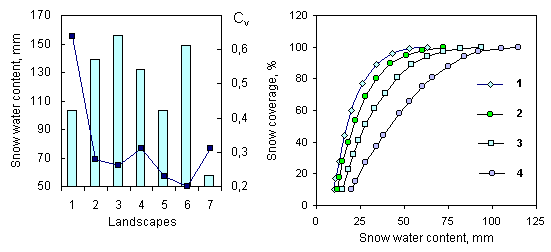 3. By an analogy to the above mentioned, we must taken the spatial variability of soil water properties into account as responsible for infiltration and runoff. It is the most respective to those factors of seasonally frozen grounds which are particularly unstable along with thawing and spring surface runoff generation. The author have estimated the conditions which promote for impermeable layer occurred within upper soil and studied spatial distribution of this layer throughout a watershed area (Shutov and Belolutskaja, 1990). 4. Field measurements carried out with use of neutron probe (Kapotov and Shutov, 1993) testify that soil water contents within upper 1m soil layer can vary from 76 to 343 mm for various soil texture (sands to loamy soil). The empirical non-linear relationship between evaporation and soil moisture can serve to estimate the variability of the latent heat flux into the atmospheric surface layer. It is noteworthy that such variations appear to be of importance where soil texture is non-homogenous and for drought conditions (Figure 2).
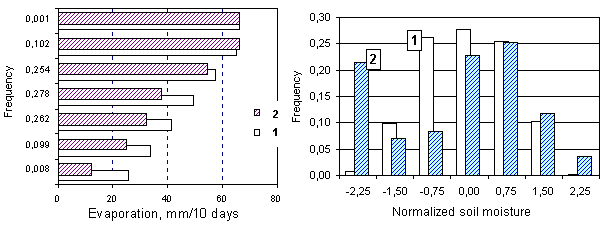 Based on the above empirical relationship the method has been improved for evaporation as spatially varied within an area in order of square mile (Shutov, 1998). Non-homogenous texture of the soil cover results in the overestimating the evaporation (and the latent heat flux, respectively) by drought conditions if the above mentioned non-linear dependence would be disregarded. Indeed, the nature realizes some feedback effect when drought entail lower evaporative loss. Thus, by development LPSs, the spatially uniform precipitation, SWE and soil water properties are not admissible, it needs to some statistical estimators be given in addition. References
[an error occurred while processing this directive] |
|
|
|
Hydrosphere © 1990 — 2005 Vladimir A. Shutov |