
|
| Welcome | Prospects | Projects | Publications | Papers |
| Methods | Purposes | Other | Links |  |
Continuing the field investigations in technogeneous wetlandsActivity in research for the improvement of the pipeline environment already conducts routinely (see applied_hydrology). We have proved that even initial stage of the large pipeline construction can violate the vital environmental conditions, in particular, the overland outflow is being constrained when the big pipe laid across flow path creates a local pool even by the driest season like of the 2002 summer.
I shall not profess here on the project performance. Principal is that only drainage could be proffered to improve the environment. Both surface relief and position of the pipeline make overland and sub-surface flows to be effective mainly beyond the pipe. Laying a gutter along the pipe or transversal drains in its embankment to shed water are not sufficient. To design drainage, there should be necessary data on frequency of the inflow to drains by rainstorms and snow melt. These have been obtained from observations. Based on the water balance approach and using soil water properties, we have determined inter-drain spaces by using approved methods. What issues were addressed? First, the evaluation of exceedance probability of the water inflow rates, second, detailed investigations in the soil physical properties in-situ. One more aspect of the problem consists of that landscapes of wetlands can long remain stable, unresponsive to a drainage. This can be featured (and partially explained) by the water budget components. Multi-year observations carried out at Wetland Research Station testifies (Table) that over drained wetland landscapes the snow (SWE) is greatly accumulated due to growing trees and rough surface (canals, dikes, etc.), but the evapotranspiration rate decreases in comparison to that for a native bog due to a deeper ground water table and, consequently, lower soil moisture content. Thus, drained wetland firmly "resists" to further artificial drainage. Table. Water budget components for wetland landscapes by long-term observations
Specifications: SWE - snow water equivalent, SWE Ratio - ratio SWE to precipitation totals Conversely, the intact non-forested wetland landscapes, e.g. the so-called "hollow-ridge complex", which are usually spread over the area, are less capable of snow accumulation due to snow drifting across the open wide plains. At the same time, evaporation losses can even exceed those for bare soil due to transpiration of the wetland grass and dwarf shrubs. Of special technical issue, the local vertical drainage through special wells equipped with submersible water pumps was addressed. There appears a problem, how to evaluate correctly the extreme value of inflow to this well, and then what a type of submersible pumps to use. They could be approached with the use of geo-hydrodynamic equations like of Theis and Jacob-Hantush, and the ECWATECH-2002 trade fair catalogue as well. |
|
|
|
Hydrosphere © 1990 — 2005 Vladimir A. Shutov |
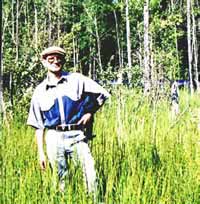 Year by year, these pools incessantly enlarged become a widely spread wetland area (Figure), covered by special vegetation (seed, reed, etc.). At least three natural factors contribute to the wetland enlargement: (1) climate wetness (high precipitation amounts), (2) lowland situation predisposed to flooding and (3) impervious soils of fine texture (silt loam, clay). All of these are permanently existent in the study area (north-west of Russia), acting together with the technogeneous forcing (underground pipelines) they can transform natural mixed forests to an oppressed shrubs.