
|
| Welcome | Prospects | Projects | Publications | Papers |
| Methods | Purposes | Other | Links |  |
On the Investigations for Gas Pipeline Engineering in Russia and Belorussia(Extended abstract of the report on ECWATECH-2002, Moscow, 4-7 June) The applied research, which results has been published earlier (Shutov and Kapotov, 1996, 1998, 2000) are continued for hydrological support of gas pipeline projects, including the pipeline from Smolensk (Russia) to the Poland frontier. Basic part of the project was calculating the parameters of spring (snowmelt) and rainfall-originated floods on those small rivers traversed by pipeline to likely estimate and mitigate hazard of local inundation. Spring flood discharges were calculated using empirical equation, reduction type, as recommended by generally accepted manuals, and a regional method. Regional empirical relationships (Fig. 1) have been obtained between flood flow characteristics and physiographic features of drainage basins. Dependencies of this kind were used to update and improve the calculation procedures. For estimating the parameters of adopted equations, the observation data at the analogue (model) watersheds have been used. The latter have been identified objectively resulting from cluster analysis of the watershed attributes and flood flow parameters. Also, the homogeneous regions have been distinguished, whose hydrological attributes may be specified properly. The low flow data are necessary to evaluate the water resources available and waste water releases which will be permitted for Gas Pumping Stations (GPSs). For evaluating the low flow of small rivers, the analogues have been selected based upon similarity in the aquifers generating ground water discharge (the base flow). The parameters of respective equation for the low flow have been identified for vicinity of each GPS. With the use of the soil maps available, the distribution of the genetic and textural soil types along the pipeline route has been studied. Based on previous experimental research results, the main soil water properties were provided, first of all the soil water capacities, permeability and water yield coefficients. The FAO/UNESCO soil classification was used to determine the resil-ience of soils to an impact. Resulting from the analyses, those sections (Fig. 2) of the pipeline route have been identified where the environmental impact of the pipeline construction will be significant. Based upon the previous experience, we suggest the program of special investiga-tions which are to be implemented there prior to construction. 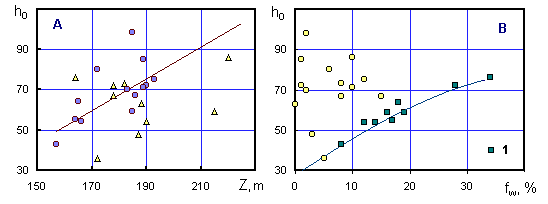 Figure 1. Examples of the regional relationships providing accuracy in runoff calculations Spring runoff depth (h0) vs. elevation of terrain (left) and wetland partial area (right), for the Polesje region, abounded in lowland swamps in particular (dark points and the curve drawn). 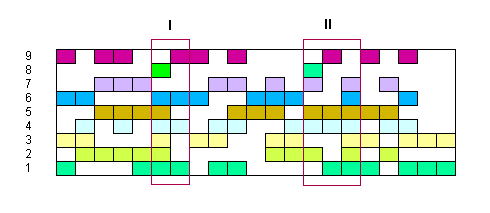 Figure 2. Environmental risk components identified along the pipeline route The components are: 1 - destruction of arable land, 2 - felling the forests, 3 - soil water erosion, 4 - local flooding, 5 - disturbance of wetlands, 6 - changes in ground water flow, 7 - deteriora-tion of water quality, 8 - troubles for reservation habitat, 9 - accidental waste water releases. References Shutov, V.A. and Kapotov, A.A. 1996. Applied aspects of the hydrological regionalization in the North of European Russia. - Meteorol. and Hydrol., No. 3, pp. 104-112 (in Russian). Shutov, V.A. and Kapotov, A.A. 1998. Application of regional hydrology for the design of a pipeline route in north Russia. - In: H. Wheater and C. Kirby (Eds.) "Hydrology in a Chang-ing Environment". - John Wiley and Sons, Chichester. Vol. III, pp. 247-252 Shutov, V.A. and Kapotov, A.A. 2000. Applied hydrology for gas pipeline engineering - In: D.L. Kane (Ed.) "Water Resources in Extreme Environment". Proc. of the AWRA Spring Spe-cialty Conf., Anchorage, Alaska, USA, 1-3 May 2000, pp. 275-280 |
|
|
|
Hydrosphere © 1990 — 2005 Vladimir A. Shutov |