|
| Welcome | Prospects | Projects | Publications | Papers |
| Methods | Purposes | Other | Links |  |
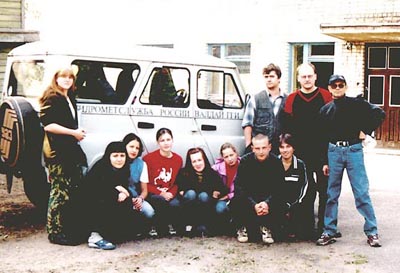
Student practice of the 2002 summer
Of the lecture courses which I am able to profess, students from the Hydromet University, St. Petersburg listened to evapotranspiration and soil moisture measurements and modelling studies. They stayed here only two weeks that is too little time to be skilled in making the observations. However, we have outlined them the rainfall gauges, lysimeters, runoff plots and small catchments properly equipped for the water budget studies. They can manipulate with the neutron probe device as well as drill the boreholes and sample the soil cores. Then we discussed about the measurement results, their respective errors, originated both by sampling procedures and by natural variability. The students tried to handle the data using a computer to draw maps, diagrams and find correlation between the variables. Doing so, they perceived how the water budget components range for various conditions and what are difficulties to determine them through field investigations. Precise measurement data served as input to simulation models both "lumped" and more sophisticated, physically-based. Usually, I introduce how the models can adopt the data and empirically-based relationships. For instance, I developed the Green-Ampt model and its recent variances for rain water infiltration by using the measured data on soil moisture, its profile and spatial variability. Also, we can look at how varied soil water properties (see joint_PDF) can effect the surface runoff conditions. We can presently see on what the actual runoff is owing to the measurements on runoff plot. Finally, the students were listening about our research and developments which resulted from observational data. So, I have noted about the actual problems related to construction engineering, using as an example our studies in pipeline environment. I still remember on how I learned hydrology and got my skill by working at the Wetland Research Station in late 1970s. In particular, I then studied the peat soil physics under the guidance of Prof. K. Ivanov who was one of the prominent scientists especially in wetland hydrology. He was a true founder of that Wetland Station where I have got my basic attainments. I even saved the concise of that time, for instance, on what the filtration flow through peat soil is and how it can be measured in-situ and in laboratory. |
|
|
|
Hydrosphere © 1990 — 2005 Vladimir A. Shutov |