The year 2002 current activities and future aims
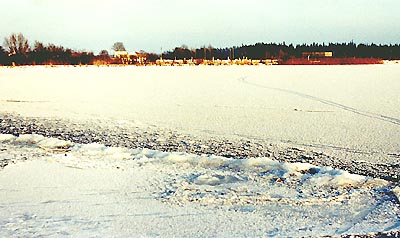
Nature is going to fall asleep, perhaps too early. The time is to sum up the year 2002 research activities and, briefly, their results:
- Assessing the climate-related effects of the snow cover
- Statistical modeling of the rainfall fields to be used in validation of the satellite-based rainfall as well as snowfall and the SWE estimates;
- Calculations, mapping and analyses of the total water inflow to the artificially created technogeneous wetlands (see also recent_studies) to be drained;
- Reviewing the region-scale water resources and water economy problems which were addressed on the ECWATECH-2002, Moscow;
As to be proposed for the near (some three years ahead) future:
- Experimental studies of the snow pack, snow drifting and snow melt at an index plot equipped with gauges for precise ground-based precipitation measurements;
- Improvements in the weather radar and the satellite-borne sensor calibration methodologies with reference to operational hydrology (flood forecasting);
- Correction of the existing retrieval algorithms for satellite-based precipitation and SWEs;
- Improvement and updating of the snow accumulation and snowmelt routines within river runoff and regional climate simulation models;
- Correct spatial evaluations of the snow water equivalent over river basins (to be implied to flood flow forecasting and reservoir management);
And, of those interesting the more wide audience of explorers:
- Summarizing the Russian experience in applied snow hydrology (to write a book);
- Review of the environmental risk assessment methodology to support engineering of the large linear constructions (e.g., gas pipelines).
The problem appears how to make our results useful for wide applications! Unfortunately, we still cannot contribute to (as well as initiate) such ambitious experiments as the Cold Land Process Experiment (CLPX) carried out at Colorado Front Range by the NASA's Goddard Space Flight Center (http://www.gsfc.nasa.gov/topstory/coldland.shtml). Sagacious is there parallel surveys from satellites, aircraft and at the land surface, at two different spatial scales. This resembles our earlier approach briefly expounded here in Snow_Book.
|